

The cruise line’s “cancel for any reason” offer and a real Cancel For Any Reason (CFAR) insurance policy are two different things, and mixing them up is one of the most expensive mistakes I see travelers make before they book. One usually gives you a future cruise credit if you back out; the other can put real money back in your bank account. Here’s exactly how each one works in 2026, what each actually pays, and how I’d decide which (if either) is worth the money.
I’m Steve Griswold. My wife Lisa and I run Pixie Vacations, a family-owned agency, and we book cruises across every major line at no extra cost to you. This question — “do I buy the line’s protection plan, a third-party policy, or nothing?” — comes up on almost every cruise booking, so I wanted to lay it out plainly.
First, the distinction that trips everyone up
When a cruise line sells you its “travel protection” or “vacation protection” plan, that plan usually has two halves:
- The insurance half — for covered reasons (you get sick, you’re injured, a close family member dies), it reimburses part or all of your prepaid cruise fare, often in cash up to a limit.
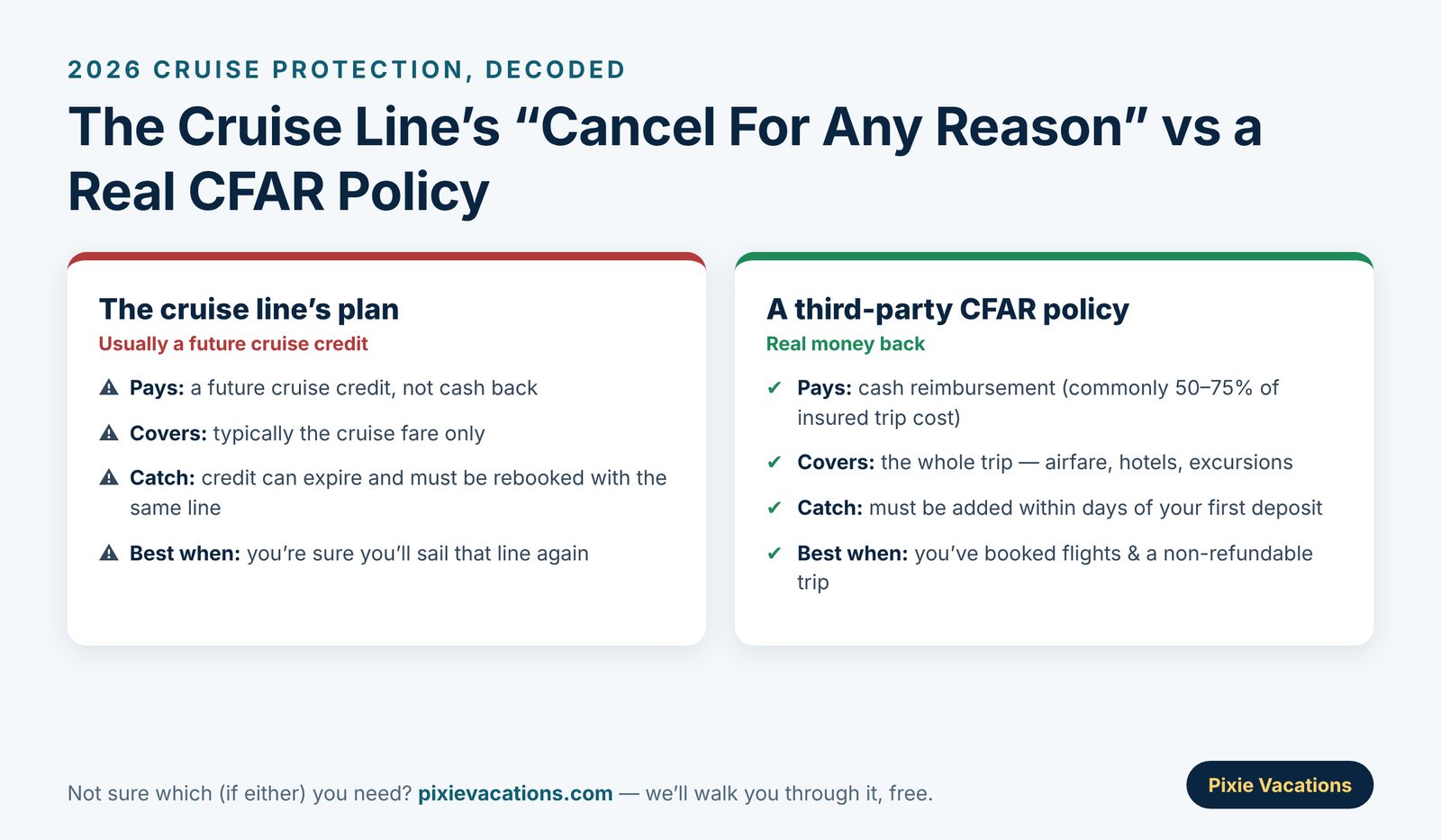
- The “cancel for any reason” half — if you cancel for a reason that isn’t on the covered list (you changed your mind, work blew up, you’re just nervous), the line gives you a future cruise credit, not cash.
A standalone, third-party CFAR policy is a different animal. It’s an upgrade you add to a comprehensive travel-insurance plan, and when you use it you get cash back — typically 50% or 75% of your non-refundable trip cost — no matter why you cancel. The words sound the same. The payout is not.
What each option actually pays (October 2026)
Here’s how the most common choices stack up. Figures are current as of October 2026; exact terms change by policy version, fare type, and your state of residence, so always read the wording on the plan you’re actually offered before you buy.
| Option | If you cancel for a covered reason | If you cancel for any reason | Payout form | When you must buy it |
|---|---|---|---|---|
| Cruise line protection plan (Royal Caribbean style) | Up to 100% of cruise fare | Around 90% of the non-refundable cruise fare | Covered = cash; “any reason” = future cruise credit | After deposit, but before final payment |
| Cruise line protection plan (Disney Cruise Line style) | Trip cost reimbursed up to a limit | A portion of the cancellation fee | Covered = cash; non-covered = future cruise credit | By your final payment date (earlier if your deposit is already non-refundable, e.g. concierge and suites) |
| Third-party CFAR (add-on to a comprehensive policy) | Up to 100% of insured trip cost | 50% or 75% of non-refundable trip cost | Cash both ways | Usually within 14–21 days of your first deposit |
| No protection | Only whatever the fare’s own cancellation schedule refunds | Whatever the fare’s schedule refunds (often nothing close to sailing) | Partial fare refund per schedule, if any | n/a |
Five things the top articles don’t tell you
Most “cruise insurance” pages stop at “yes, buy insurance.” These are the details that actually change the decision:
- A “future cruise credit” is only worth something if you’ll definitely cruise that line again, on their timeline. The line’s cancel-for-any-reason credit usually expires inside 12–24 months and is tied to that one cruise line and often one name. If you were hoping to switch lines, change ports, or just get your money back, that credit can quietly expire unused. Cash from a CFAR policy doesn’t care who you sail next.
- Real CFAR has a short buying window, and it’s measured from your first deposit — not final payment. Most third-party CFAR must be added within about 14–21 days of your initial deposit. Wait until a hurricane is named or your boss gets twitchy and the window is gone. If CFAR matters to you, it’s a day-one decision, not a final-payment one.
- CFAR almost always requires you to insure 100% of your non-refundable trip cost and to cancel in advance — commonly at least 48 hours before departure. You can’t half-insure the cruise to save money and still expect the CFAR benefit, and you can’t use it from the pier. Cancel the day before and you may fall outside the window.
- The cruise line’s plan usually covers only what you booked through the cruise line. Your own flights, a pre-cruise hotel, parking, and excursions booked independently often aren’t protected by the line’s plan the way a full third-party travel policy protects your whole trip. For a fly-to-the-port cruise, that gap is the part that actually bankrupts a trip.
- Pre-existing medical conditions are a separate clause with its own clock. Many comprehensive policies waive the pre-existing-condition exclusion only if you buy within a set window (often 14–21 days) of your first deposit and insure the full cost. Miss it and a flare-up of something you already had may not be covered at all — regardless of CFAR.
So which should you buy?
Here’s the honest version I’d give you on the phone:
- If your main worry is getting genuinely sick or hurt, a solid comprehensive travel-insurance policy (cruise line’s or third-party) is usually enough, and third-party plans often pay cash and cover your flights and hotel too.
- If your real worry is “I might just change my mind, and I want money back, not a credit,” that’s the exact job of a third-party CFAR add-on — bought early, insuring the full non-refundable cost.
- If you’re happy to re-book the same line later no matter what, the cruise line’s own “cancel for any reason” credit can be the simplest option, because you can add it right up to final payment.
- If the cruise is fully refundable until a date you’re comfortable with, you may not need to rush into anything — but know your fare’s real cancellation schedule first.
The right answer depends on your fare type, your deposit, and what you’re actually afraid of. That’s the part worth talking through before you click “book,” because some of these windows close the day you put the deposit down.
Frequently asked questions
Is the cruise line’s “cancel for any reason” the same as CFAR insurance?
No. The cruise line’s “cancel for any reason” almost always pays you a future cruise credit, while a third-party CFAR policy pays cash — typically 50% or 75% of your non-refundable trip cost. If getting money back matters more than a credit, they are not interchangeable.
How much does CFAR insurance pay back on a cruise?
A third-party CFAR add-on typically reimburses 50% or 75% of your non-refundable, insured trip cost, in cash, regardless of why you cancel. The cruise line’s own any-reason option usually returns a similar-sounding percentage, but as a future cruise credit rather than cash.
When do I have to buy CFAR for it to count?
You usually have to add third-party CFAR within about 14 to 21 days of your first cruise deposit, insure 100% of your non-refundable trip cost, and cancel at least 48 hours before departure. The cruise line’s own plan can usually be added later — after your deposit but before final payment.
Does the cruise line’s protection plan cover my flights and hotel?
Usually only partly or not at all. The cruise line’s plan is built around what you booked through the cruise line, so independently booked flights, pre-cruise hotels, and parking are often left out. A comprehensive third-party policy is what protects the whole trip.
Do I even need cruise insurance if my fare is refundable?
If your fare is fully refundable through a date you’re comfortable with, you may not need to buy protection immediately — but you should confirm the exact cancellation schedule, because most cruise fares become partly or fully non-refundable well before sailing.
Can you help me figure out the right coverage for my cruise?
Yes. We book cruises across every major line at no extra cost to you, and we’ll walk you through your fare’s real cancellation schedule and your protection options before you commit, so the timing windows don’t close on you.
Ready to book a cruise with real help included?
You can browse and book almost any cruise line yourself through our online cruise tool, and you’ll get the same prices you’d find anywhere — plus a real Griswold-family travel agent you can call before, during, and after your trip. Our family, Steve and Lisa Griswold, has been helping travelers plan vacations for years, and getting the protection decision right is exactly the kind of thing we’re here for.
Browse cruises and book online here, or request a free quote and we’ll help you sort out the coverage before you book.
Related reading: Where should you actually book a cruise? · Is Disney Cruise Line concierge worth it? · Booking a cruise for a large or multigenerational family
This article explains how cruise protection options generally work as of October 2026 and is not insurance advice. Coverage terms, percentages, and buying windows vary by plan, fare type, and your state of residence — always read the specific policy wording before you buy.